
Partnerships · Technology & Strategic Partnerships
Advancing Gene Therapies Through Strategic Collaboration
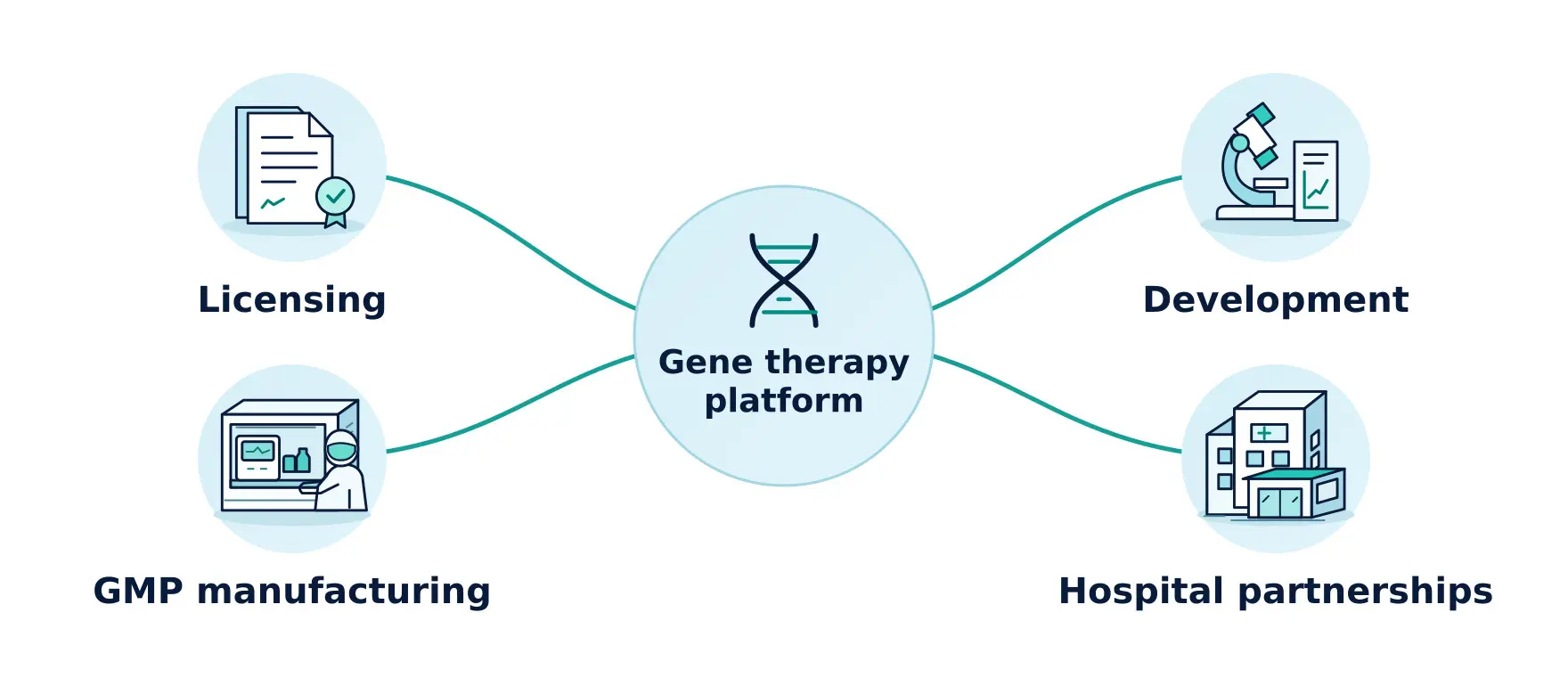
Nouvogenes works to connect innovative gene therapy technologies with clinical development, regulatory execution, GMP manufacturing coordination, and specialist treatment networks—starting in Thailand and expanding selectively through international partnerships.
Clinical and regulatory status: RM-001 is investigational and is not approved for routine commercial use. No hospital becomes an authorized treatment center by expressing interest or entering preliminary partnership discussions. Clinical trial activities are limited to appropriately approved sites and protocols. Future treatment-center arrangements depend on applicable authorizations and institutional readiness.
Our partnership proposition
From promising science to a viable treatment pathway
For a novel gene therapy, scientific innovation is only the beginning. Development requires an integrated plan spanning clinical evidence, regulatory submissions, product quality, specialist treatment infrastructure, and a sustainable route to patient access.
A focused development partner
Nouvogenes is building this integrated capability through RM-001, its investigational autologous CRISPR/Cas9-edited stem-cell therapy for transfusion-dependent β-thalassemia. Our role combines technology-partner collaboration, local clinical and regulatory development, GMP manufacturing coordination, and hospital-network development.
We are interested in selective collaborations where these capabilities can materially improve a program's development feasibility and long-term access prospects.
What guides our approach
Patient need: a meaningful unmet medical need and credible therapeutic rationale.
Scientific evidence: a defensible mechanism, reproducible data, and an appropriate development plan.
Execution: feasible manufacturing, quality, clinical, and regulatory requirements.
Sustainability: a realistic pathway to treatment delivery, funding, and long-term follow-up.
Potential collaboration models
Flexible structures for different stages of innovation
Partnership arrangements would be tailored to the technology, development stage, geography, responsibilities, and agreed commercial terms. The models below are opportunities for discussion, not announcements of signed agreements.
01 · Licensing
Regional technology licensing
Explore territorial rights to develop, register, and commercialize differentiated gene therapies in agreed locations, with clear intellectual-property, data, and economic arrangements.
02 · Development
Clinical and regulatory co-development
Consider joint plans for clinical evidence generation, trial operations, regulatory engagement, and evidence packages appropriate to the target jurisdiction.
03 · Manufacturing
Process transfer and GMP collaboration
Coordinate manufacturing feasibility, technology transfer, comparability, quality systems, testing, supply logistics, and scale-up with qualified manufacturing partners.
04 · Access
Treatment and referral networks
Work with hospitals and clinical partners on specialist treatment-center readiness, appropriate referral pathways, and follow-up systems.
05 · Research
Academic and translational partnerships
Evaluate scientific collaborations that address relevant biological questions, clinical translation, and future therapeutic opportunities.
06 · Strategy
Long-term strategic alliances
Explore multi-program or capability-based partnerships where governance, milestones, funding, and responsibilities are aligned.
Platform capabilities
Connecting the disciplines that determine development success
Our RM-001 program provides a foundation for evaluating future opportunities. The scope of any new program would depend on technical diligence, resources, partner agreements, and regulatory requirements.
Clinical and regulatory development
Thailand-focused clinical development planning, specialist investigator collaboration, trial oversight, regulatory documentation, and evidence-generation strategy.
Manufacturing and quality interface
Experience coordinating an autologous cell-therapy manufacturing pathway, including technology transfer, product-quality considerations, logistics, and GMP partner interfaces.
Hospital partnership development
Relationships and operating models designed to connect referring clinicians, apheresis services, transplant teams, manufacturing, and longitudinal patient follow-up.
Commercialization planning
Assessment of eligible populations, treatment-center capacity, payor and funding pathways, and the practical requirements for responsible adoption following applicable authorization.

How we assess opportunities
Disciplined selection, not pipeline expansion for its own sake
We prioritize opportunities that complement the company's capabilities while protecting focus and resources for RM-001.
01 · Clinical value
Unmet need and patient impact
Assess disease burden, current standards of care, clinical differentiation, and meaningful outcomes for patients.
02 · Evidence
Scientific and clinical maturity
Review nonclinical and clinical data, durability signals, safety questions, and remaining evidence gaps.
03 · Feasibility
Technical and operational fit
Examine manufacturing complexity, product quality, treatment infrastructure, supply chain, and local development feasibility.
04 · Rights
Intellectual property and governance
Evaluate licensing scope, freedom-to-operate considerations, decision rights, data access, and partner accountability.
05 · Access
Regulatory and payor pathways
Assess evidence expectations, potential funding mechanisms, affordability, and treatment-network readiness.
06 · Economics
Capital efficiency and alignment
Test milestone funding, execution risk, partnership economics, and sustainable long-term delivery.
Partnership journey
A practical pathway from introduction to collaboration
Each opportunity follows a proportionate, confidential, and evidence-led evaluation process.
01 · Introduction
Strategic fit discussion
Discuss the therapeutic opportunity, partner objectives, proposed geography, and potential collaboration scope.
02 · Evaluation
Scientific and operational diligence
Subject to appropriate confidentiality arrangements, review evidence, intellectual property, CMC, clinical requirements, and resource needs.
03 · Design
Development and access plan
Define milestones, responsibilities, budgets, manufacturing strategy, regulatory workstreams, and governance.
04 · Agreement
Aligned partnership terms
Agree on rights, economics, decision-making, quality responsibilities, data arrangements, and risk allocation.
05 · Execution
Milestone-based collaboration
Implement the agreed program with defined oversight, reporting, and appropriate clinical and regulatory safeguards.
Collaborate with Nouvogenes
Let's explore what we could build together
We welcome introductions from gene therapy developers, technology licensors, academic groups, GMP manufacturing organizations, and strategic partners with a clearly defined therapeutic or capability proposition.
Helpful information for a first discussion
Therapeutic indication and mechanism; development stage and available evidence; anticipated manufacturing platform; proposed geographic scope; intellectual-property or licensing position; and the partnership outcomes you seek.
Confidential information should be shared only after appropriate arrangements are in place.
Interested in a strategic partnership?
Contact Nouvogenes to discuss potential alignment and an appropriate next step. An initial discussion does not constitute a commitment to license, fund, develop, or commercialize a product.
Our long-term direction
One focused lead program. A platform for future collaboration.
RM-001 remains Nouvogenes' development priority. Our future portfolio will grow selectively through partnerships that combine strong science with credible clinical execution and a responsible path to patient access.