
Patients & Healthcare Professionals · For Physicians
RM-001: Clinical Information for Physicians
A clinical overview for hematologists, transplant teams, and physicians caring for people with transfusion-dependent beta-thalassemia.
Investigational therapy: RM-001 is not approved for routine commercial use. Information on this page is educational and does not supersede the approved clinical trial protocol, investigator brochure, informed-consent materials, or decisions by the treating and study teams.
Therapeutic rationale
Autologous gene-edited stem cells designed to reactivate fetal hemoglobin
RM-001 is an investigational, ex vivo CRISPR/Cas9 gene-edited CD34+ hematopoietic stem-cell therapy for transfusion-dependent beta-thalassemia (TDT).
Patient-derived CD34+ cells are collected, selected, and edited at the HBG1/HBG2 promoter region using CRISPR/Cas9 nucleofection. The intended biological effect is increased γ-globin expression and fetal hemoglobin (HbF) production after engraftment.
The approach is designed to address the underlying hemoglobin deficit and achieve durable transfusion independence. The actual degree and durability of clinical benefit remain subjects of clinical evaluation.
At a glance
Modality: Autologous, ex vivo CRISPR/Cas9-edited CD34+ stem cells.
Target: HBG1/HBG2 promoter region.
Clinical goal: Sustained transfusion independence with adequate hemoglobin.
Current status: Investigational; clinical development in Thailand.
Clinical development
Evidence generation in Thailand
Following Thai FDA authorization of the investigational clinical study in October 2026, RM-001 is being evaluated in a planned eight-participant clinical development program.
Study populationTransfusion-dependent β-thalassemia
Planned enrollment8 participants
Age-based cohorts18–35, 12–17, and 6–11 years
Primary efficacy assessmentTransfusion independence ≥12 months with Hb ≥9 g/dL
The primary efficacy assessment is a protocol-defined study objective, not an achieved outcome. Detailed endpoint definitions, analysis sets, eligibility requirements, and safety procedures must be checked against the current approved protocol.
Prior clinical experience
Clinical experience from the technology developer's China program provides a rationale for further study, including reported transfusion-independent responses and HbF production. Interpretation requires review of the relevant data cut, patient population, follow-up duration, safety findings, and source documentation.
Evidence resources
See the dedicated clinical evidence page for the development context, endpoint framework, and limitations of the available evidence.
Multidisciplinary care pathway
From assessment to long-term follow-up
RM-001 requires coordinated care across hematology, apheresis, GMP manufacturing, transplant medicine, and long-term surveillance.
01 · Screening
Clinical eligibility assessment
Confirm TDT diagnosis and disease history; review transfusion burden, iron overload, organ function, infectious risks, comorbidities, and protocol-specific eligibility.
02 · Collection
Mobilization and apheresis
Mobilize and collect autologous stem cells under the study-defined procedures, with assessment of collection adequacy and patient safety.
03 · Manufacturing
CD34+ selection and editing
Select CD34+ cells, perform ex vivo CRISPR/Cas9 nucleofection, and complete applicable manufacturing and product-release testing.
04 · Conditioning
Transplant preparation
Administer protocol-specified myeloablative conditioning with supportive care, infection prevention, and relevant fertility counseling.
05 · Infusion
Cell infusion and engraftment
Infuse the investigational product and monitor engraftment, hematologic recovery, complications, and transfusion requirements.
06 · Surveillance
Long-term monitoring
Follow hemoglobin and HbF responses, transfusion independence, organ health, and late adverse events according to the protocol and follow-up plan.
Patient selection
Who should be considered for specialist evaluation?
Potential candidates are people with transfusion-dependent beta-thalassemia who may be appropriate for intensive autologous stem-cell therapy evaluation.
Initial clinical considerations
Referring clinicians may review the patient's transfusion history, disease complications, prior therapies, overall fitness, organ function, infection status, and ability to participate in prolonged follow-up.
Age alone does not establish eligibility. The Thai study is structured into adult, adolescent, and pediatric cohorts, with cohort progression subject to protocol-defined safety oversight.
Protocol determines eligibility
Formal inclusion and exclusion criteria, laboratory thresholds, cardiac assessments, liver evaluation, imaging, and other screening requirements must be applied by the authorized study team using the current approved protocol.
Do not use this overview as a screening checklist or substitute for study documentation.
Safety and benefit-risk
Clinical risks require careful assessment
Potential benefits must be weighed against the risks of stem-cell collection, conditioning, transplantation, gene editing, and prolonged follow-up.
Conditioning and transplant-related risks
Myelosuppression, serious infection, bleeding, mucosal injury, organ toxicity, infertility risk, and other acute or delayed complications warrant specialist counseling and monitoring.
Gene-editing and product-related uncertainties
Editing efficiency, off-target or unintended editing outcomes, product consistency, engraftment, and potential late effects require appropriate testing and ongoing surveillance.
Response and durability
Transfusion independence and Hb/HbF responses may vary. The durability of response and long-term safety profile must be established through follow-up.
The safety information above is a general overview; consult the investigator brochure, approved protocol, product documentation, and study safety reporting procedures for authoritative study-specific requirements.
For transplant physicians and aspiring treatment centers
Delivering RM-001 at a qualified treatment center
Physicians visiting this page may already practice at a specialist hematopoietic stem cell transplantation center, or may be helping their institution develop the capabilities needed to become a future RM-001 treatment center. Nouvogenes welcomes professional dialogue with both groups.
The role of the transplanting physician
At a qualified treatment center, the responsible hematology and transplant team would lead multidisciplinary eligibility assessment, patient counseling and informed consent, preparation for apheresis, conditioning and cell infusion, engraftment monitoring, management of transplant-related complications, and long-term clinical follow-up. Exact responsibilities are governed by the applicable protocol, institutional procedures, and regulatory requirements.
Building institutional readiness
Hospitals considering a future treatment-center role should assess their stem cell collection and transplantation experience, appropriately controlled inpatient facilities, infection prevention and supportive care, access to specialist laboratory and transfusion services, trained multidisciplinary personnel, chain-of-identity and chain-of-custody procedures, emergency response capability, and capacity for prolonged follow-up.
Explore treatment-center collaboration
Nouvogenes aims to work with experienced transplantation teams and institutions seeking to build appropriate capabilities, including discussions of clinical workflows, training needs, manufacturing coordination, quality systems, and institutional readiness.
Interest in collaboration does not establish center qualification or authorization. Any future RM-001 administration must occur only under the relevant approvals, site qualifications, and clinical or regulatory requirements. Physicians and hospital leaders may contact Nouvogenes through its official channels to initiate a discussion.

Professional collaboration
Connecting referring physicians and specialist treatment teams
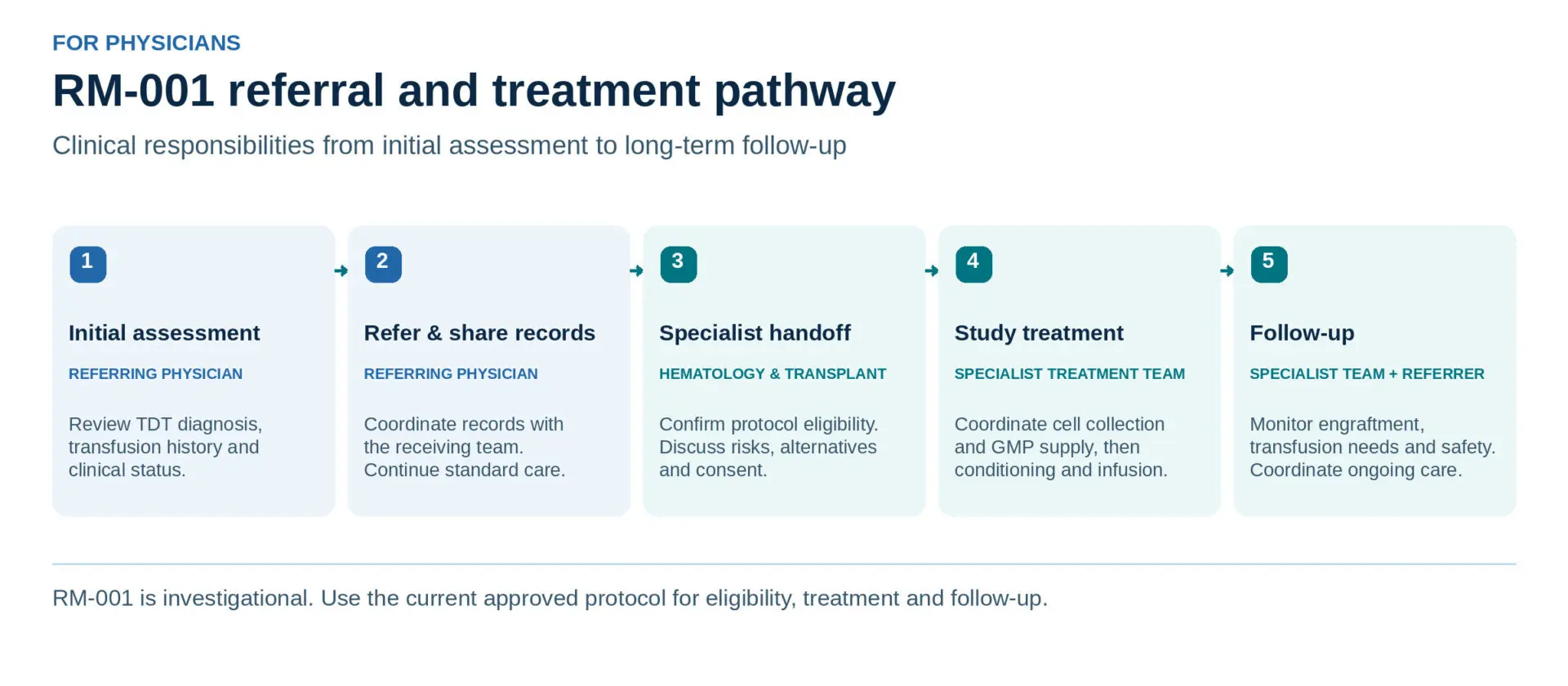
Effective care depends on coordinated patient identification, medical record review, specialist evaluation, treatment planning, and follow-up.
Role of the referring physician
Help identify patients who may benefit from a discussion of emerging treatment options, maintain standard-of-care management, and coordinate medical information with the receiving hematology and transplant team when appropriate.
Role of the specialist center
Assess protocol eligibility, explain risks and alternatives, conduct required procedures, and oversee transplantation and longitudinal safety monitoring.
Clinical trial inquiries
Participation is subject to active enrollment, institutional processes, protocol eligibility, informed consent, and study-team authorization.
Physicians seeking collaboration or further information may contact Nouvogenes through its official communication channels. No patient-specific information should be submitted through a general website inquiry.
Further scientific information
Explore the RM-001 clinical program
Review the therapeutic approach and clinical evidence overview. Medical decisions must be based on the current approved trial documents and the treating team's clinical judgment.
For healthcare-professional education only. RM-001 remains investigational and is not approved for commercial use.