Patients & Healthcare Professionals · For Patients & Families
Understanding RM-001 Gene Therapy
Information for people living with transfusion-dependent beta-thalassemia and the families supporting them.
Important: RM-001 is an investigational gene therapy. It has not been approved for routine commercial use. This page is educational and does not replace advice from your healthcare team.
The condition
What is transfusion-dependent beta-thalassemia?
Beta-thalassemia is an inherited blood condition that affects the body's ability to make enough healthy hemoglobin, the protein in red blood cells that carries oxygen.
People with severe beta-thalassemia may need regular blood transfusions to maintain adequate hemoglobin levels. They may also require treatment to manage iron buildup and ongoing specialist monitoring.
These treatments can be lifesaving, but the need for repeated hospital visits and long-term care can place a considerable burden on patients and families.
Why hemoglobin matters
Hemoglobin helps carry oxygen throughout the body. When the body cannot make enough functioning hemoglobin, anemia can cause tiredness and other health problems.
Each person's condition and treatment needs are different. A hematologist can explain what these differences mean for you.
The investigational approach
How is RM-001 designed to work?
RM-001 is being studied as a one-time, personalized gene therapy that uses a patient's own blood-forming stem cells.
01 · Your cells
Collect
Blood-forming stem cells are collected from the patient through a specialist procedure called apheresis, following preparation by the treatment team.
02 · Laboratory editing
Edit
In a controlled manufacturing facility, CRISPR/Cas9 is used to edit the collected cells with the aim of increasing fetal hemoglobin production.
03 · Return to the patient
Infuse
After preparation for transplantation, the edited cells are infused back into the patient so they can establish themselves and produce blood cells.
The goal is to help the body produce enough functional hemoglobin to eliminate the need for regular transfusions. This outcome is not guaranteed and remains under clinical investigation.
The care pathway
What might the treatment journey involve?
RM-001 is not a routine injection. It involves several stages of specialized care and close follow-up.
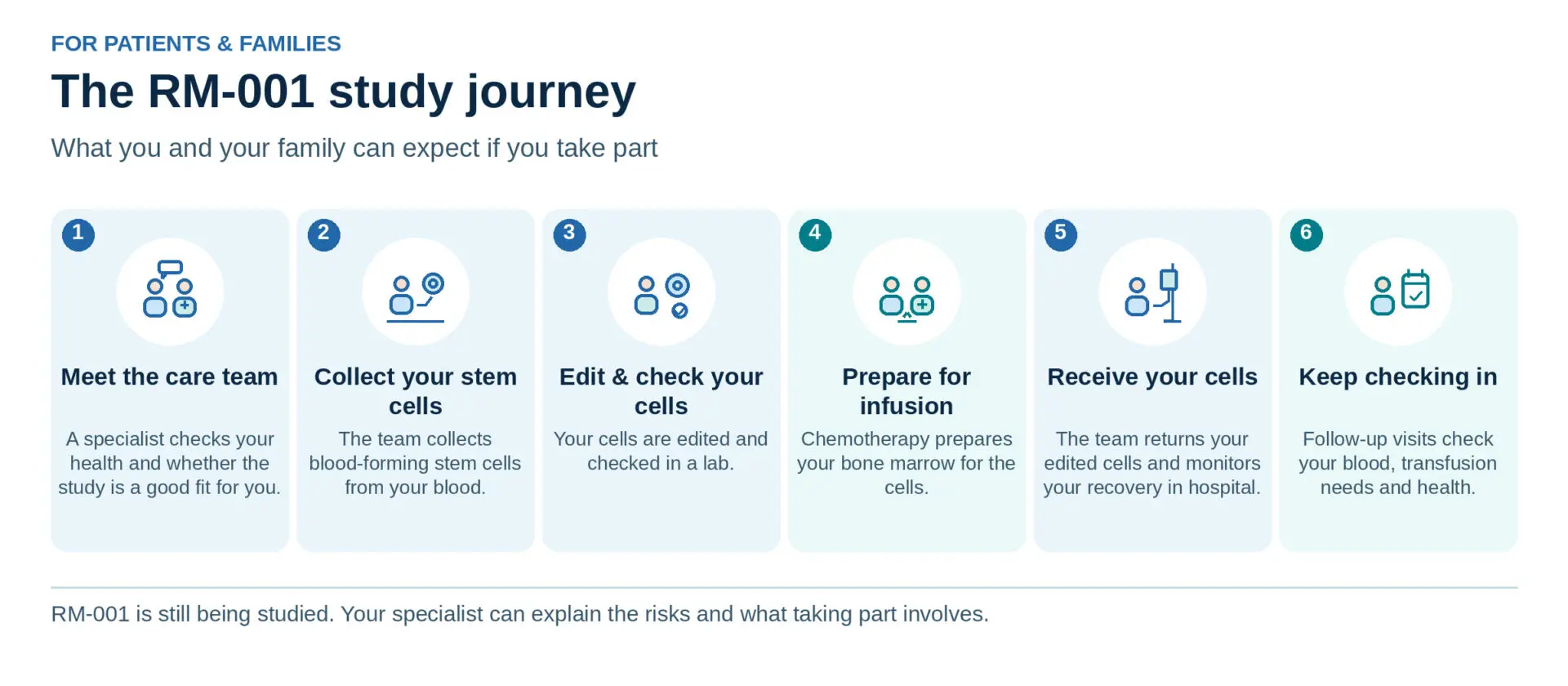
Step 1
Eligibility assessment
A specialist team reviews medical history, transfusion needs, organ health, laboratory tests, and clinical trial criteria.
Step 2
Stem cell collection
Stem cells are mobilized into the bloodstream and collected through apheresis.
Step 3
Cell manufacturing
The cells are edited and undergo quality testing before they can be considered for infusion.
Step 4
Conditioning treatment
Patients receive conditioning chemotherapy to prepare the bone marrow to receive the edited cells.
Step 5
Infusion and recovery
The edited cells are infused. Hospital-based monitoring continues while blood cell counts recover and the cells engraft.
Step 6
Long-term follow-up
Ongoing visits and tests assess safety, hemoglobin levels, transfusion needs, and longer-term outcomes.
Benefits and uncertainties
What should patients and families consider?
The aim of RM-001 is transfusion independence, but gene therapy is complex and involves important medical risks and uncertainties.
Potential benefit under investigation
RM-001 is designed to increase fetal hemoglobin, with the goal of enabling patients to live without regular blood transfusions. Researchers must evaluate how often this happens and how long any response lasts.
Important risks and burdens
Conditioning chemotherapy and transplantation can cause serious complications, including infections, low blood counts, bleeding, infertility, and organ-related side effects. Cell collection, infusion, and gene editing also require careful safety evaluation. Some risks may emerge over time.
A specialist must explain the study-specific risks, alternative care options, fertility considerations, hospital stay, and follow-up requirements before any informed consent decision.

Clinical research in Thailand
Who may be eligible?
RM-001 is being evaluated in a Thai clinical development program involving adults, adolescents, and children with transfusion-dependent beta-thalassemia.
Eligibility is an individual medical decision
Being within an age group or having beta-thalassemia does not automatically make someone eligible. Study enrollment depends on detailed inclusion and exclusion criteria, organ function, clinical assessments, and the judgment of the trial team.
Only an authorized study team can determine whether a person is eligible for the clinical trial.
Study populationTransfusion-dependent beta-thalassemia
Study designEight participants planned in Thailand
Age groupsAdults, adolescents, and children
AvailabilityInvestigational; not routine treatment
Frequently asked questions
Questions patients and families often ask
Is RM-001 a cure?
RM-001 is being studied with the goal of long-term transfusion independence. It is too early to promise a cure or a particular result for an individual patient.
Does RM-001 use donor cells?
No. RM-001 is an autologous therapy, meaning it uses the patient's own stem cells, which are edited outside the body and then returned.
Can I receive RM-001 now?
RM-001 is investigational. Access, if available, is governed by the approved clinical study and its eligibility and enrollment requirements—not by a commercial booking process.
Will I need to stay in hospital?
Yes, this type of treatment generally requires specialist inpatient transplantation care and monitoring. The clinical team can explain the expected stay and recovery plan.
Will I still need transfusions?
The goal is to eliminate regular transfusions, but individual responses may vary. The trial team will monitor hemoglobin levels and transfusion requirements over time.
What should I ask my doctor?
Ask about your current treatment options, trial eligibility, possible benefits and risks, fertility preservation, costs or support arrangements, and long-term follow-up.
Talk with your care team
Start with your treating hematologist
If you or a family member has transfusion-dependent beta-thalassemia, discuss available treatment options and clinical research questions with your hematologist. Do not change or stop current treatment based on this website.
This content is intended for general education, not medical advice. Trial details and eligibility are subject to the approved protocol and applicable regulatory requirements.