
Science & Pipeline / Manufacturing & Quality
Manufacturing & Quality
Building the GMP manufacturing, quality, and supply capabilities required to translate individualized gene therapy into reliable clinical delivery and future commercial scale.
Development status: RM-001 is investigational. Commercial manufacturing capacity and regulatory approvals remain subject to development, qualification, and applicable authorization requirements.
A core operating capability
Manufacturing Is Part of the Therapy
For autologous gene therapy, manufacturing is inseparable from patient care. Each RM-001 batch begins with cells collected from an individual patient and must be processed, tested, released, and transported through a tightly coordinated clinical and quality-controlled pathway.
Nouvogenes is building an integrated manufacturing strategy that connects technology transfer, GMP clinical production, analytical testing, logistics, treatment-center coordination, and future commercial capacity. The objective is reproducible product quality and dependable treatment delivery as the clinical program progresses.
01 · Technology transfer
Establish the process
Transfer the licensed RM-001 manufacturing know-how into a qualified local operating environment, supported by process documentation, training, and verification activities.
02 · GMP & quality
Control every batch
Apply controlled manufacturing procedures, in-process monitoring, analytical testing, traceability, and formal batch disposition requirements.
03 · Commercial readiness
Plan for scale
Develop a specialized CDMO strategy with capacity, staffing, quality systems, and hospital interfaces suited to patient-specific gene therapy.
Clinical manufacturing
From Technology Transfer to GMP Clinical Supply
RM-001 manufacturing is based on ex vivo CRISPR/Cas9 editing of a patient's own CD34+ hematopoietic stem cells.
Establishing local manufacturing capability
Technology-transfer and validation activities have been undertaken with local manufacturing collaborators to support clinical-stage production in Thailand. These activities form the foundation for controlled execution of the licensed process, while ongoing operations remain subject to site-specific GMP requirements and quality oversight.
The clinical process includes CD34+ cell selection, CRISPR/Cas9 ribonucleoprotein delivery by nucleofection, formulation and cryopreservation, and defined product-quality assessments before release. RM-001 does not use a viral vector for the gene-editing step.
Our operating principle
One patient. One traceable manufacturing pathway.
Autologous manufacturing requires robust chain of identity and chain of custody—from cell collection through processing, testing, storage, shipment, and infusion—to ensure that the correct product is delivered to the correct patient.
Clinical-stage capability is not the same as commercial capacity. The manufacturing strategy distinguishes the current clinical supply network from the additional facilities, qualifications, and operational scale required for wider patient access.
Manufacturing pathway
A Controlled Process, From Collection to Release
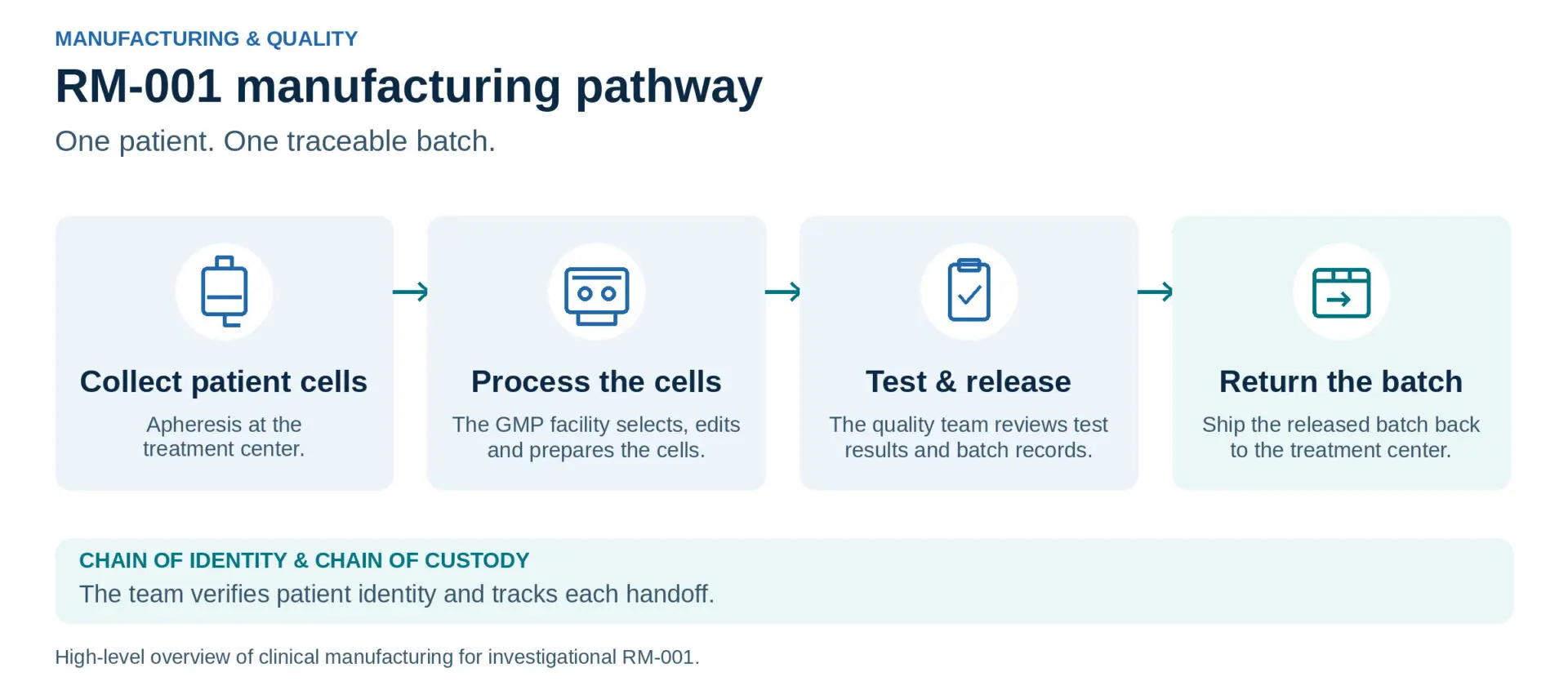
Manufacturing and clinical teams must coordinate across several dependent steps. The illustration below is a high-level overview, not a complete batch manufacturing record.
01 / Collection & receipt
Patient cell collection
Mobilization and apheresis are coordinated with the treatment hospital. Incoming material is received with identity, condition, and documentation checks.
02 / Cell processing
CD34+ selection
CD34+ cells are selected for the manufacturing process using controlled procedures and defined in-process checks.
03 / Gene editing
Ex vivo CRISPR/Cas9 nucleofection
Selected cells undergo the licensed gene-editing process targeting regulatory regions of HBG1 and HBG2, followed by appropriate processing and formulation.
04 / Quality & delivery
Testing, release, and shipment
Product-quality results and batch documentation are reviewed against defined criteria before release. Controlled storage and shipment connect manufacturing with clinical infusion.
Quality by design
Quality Must Be Built Into Every Stage
For a patient-specific cell product, reliable operations depend on both process consistency and clear quality decision-making.
Starting material & identity
Incoming cell-material controls, patient-specific identification, traceability, and documentation across handoffs.
Process controls
Qualified equipment, trained operators, controlled procedures, and monitoring of critical manufacturing steps.
Product characterization
Defined assays and specifications addressing relevant product attributes, including identity, viability, purity, gene-editing performance, and other safety-related quality parameters.
Microbiological & release testing
Appropriate contamination controls, release testing, deviations management, and quality review prior to clinical use.
Storage & logistics
Validated handling and shipping conditions, cryogenic controls where applicable, and end-to-end chain of custody.
Lifecycle oversight
Change control, comparability assessments, ongoing monitoring, and continual improvement as manufacturing evolves.
Specific acceptance criteria and analytical methods are governed by controlled development, manufacturing, and regulatory documentation and are not reproduced on this public website.
Commercial manufacturing strategy
Planning for Scalable, Specialized Capacity
Scaling autologous gene therapy requires more than increasing equipment throughput. Each patient requires a distinct production slot, qualified personnel, analytical capacity, and a coordinated treatment schedule.
A dedicated CDMO pathway
Nouvogenes' commercial manufacturing strategy includes collaboration with a specialized contract development and manufacturing organization (CDMO) to develop dedicated capacity for RM-001 and, where technically appropriate, future gene therapy programs.
Planned capacity expansion is intended to be phased alongside clinical evidence, regulatory progress, qualified operational readiness, and demand from the treatment-center network. Facility readiness, production throughput, and timing are forward-looking objectives rather than established commercial capabilities.
What scale requires
Repeatability: a controlled process that can be executed reliably across successive patient batches.
Capacity: production suites, equipment, operators, quality-control resources, and scheduling systems sized to demand.
Cost discipline: appropriate utilization, process efficiency, and management of specialized materials and testing.
Network integration: predictable coordination between referral hospitals, apheresis sites, manufacturing, and treatment centers.
Access and execution
Connecting Manufacturing to Patient Access
The goal is not simply to manufacture a cell product; it is to establish a reliable pathway through which eligible patients can receive treatment at qualified institutions.
Clinical coordination
Align cell collection, conditioning, infusion, and follow-up schedules with production and quality-release timelines.
Hospital partnerships
Work with qualified treatment centers and support the development of aspiring institutions where feasible.
Regional potential
Design a delivery model capable of supporting future cross-border referral pathways, subject to clinical, logistics, and regulatory requirements.
Explore more
From Science to Treatment Delivery
Explore how RM-001 works and how Nouvogenes is generating the clinical evidence to support its development.