Science & Pipeline / Clinical Development

Clinical Development & Evidence

Advancing RM-001 through a structured clinical development program in Thailand, informed by clinical experience with the licensed technology in China.

Evidence-led development

From Early Clinical Experience to Locally Generated Evidence

RM-001 is an autologous CRISPR/Cas9 gene-edited stem-cell therapy under development for transfusion-dependent β-thalassemia (TDT). Its clinical strategy builds on human experience with the licensed technology in China while generating evidence within Thailand's own clinical and regulatory framework.

01 · Clinical experience

Observed responses in China

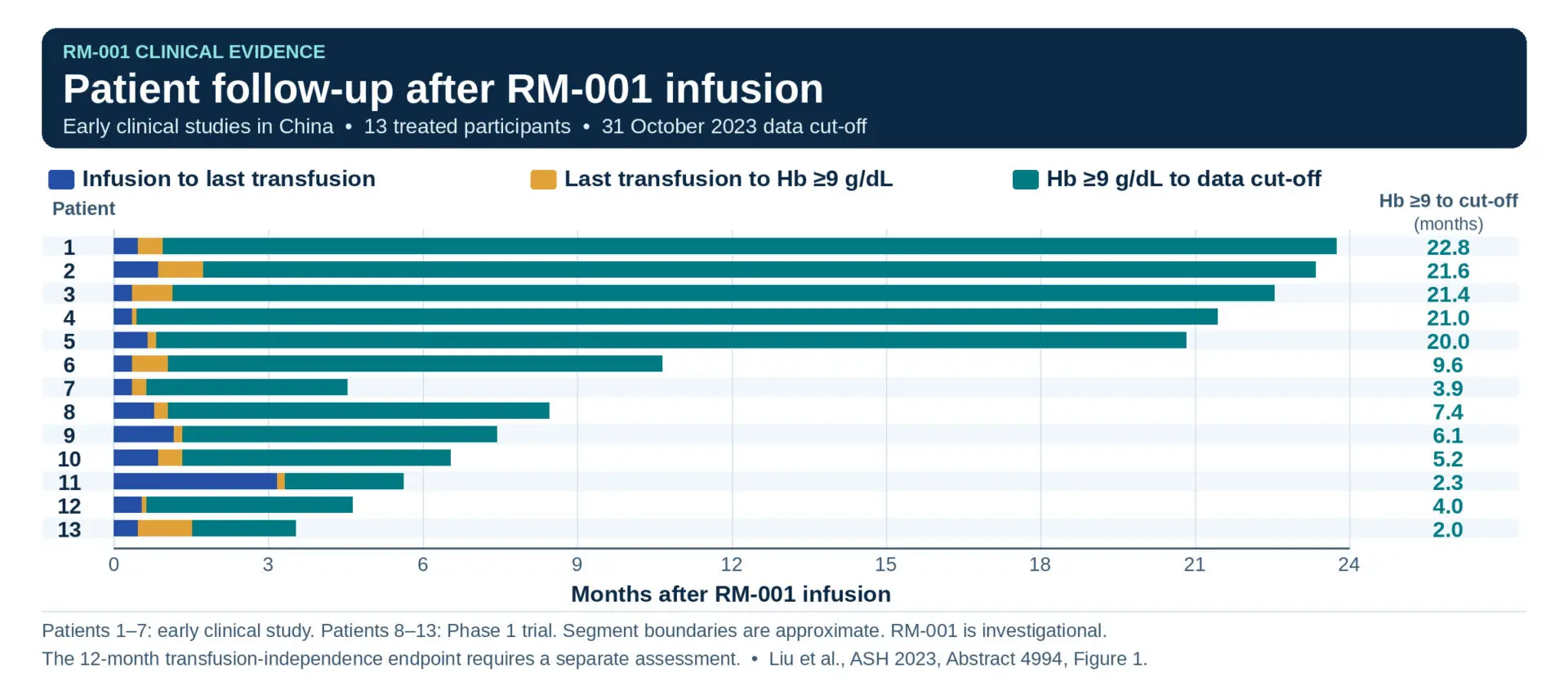
Clinical experience has reported transfusion independence and increased fetal hemoglobin in treated participants. Interpretation depends on the specific cohort, follow-up duration, and analysis cut-off.

02 · Local development

Thailand clinical program

A Thai FDA-authorized study is designed to assess safety and treatment outcomes across age-defined cohorts, supported by local clinical and manufacturing capabilities.

03 · Long-term evidence

Durability and safety follow-up

Long-term monitoring remains essential to characterize sustained transfusion independence, hematologic outcomes, and potential delayed adverse events.

Clinical experience in China

What Has Been Observed with the Licensed Technology?

Early Chinese clinical experience provides an important rationale for further development, while leaving meaningful questions for continued investigation.

Reported clinical observations

Transfusion independence and fetal hemoglobin response

Information provided for the development program describes participants achieving transfusion independence after treatment, with some patients followed for multiple years. Earlier reported patient subsets also showed increases in fetal hemoglobin. These findings should be interpreted within the context of their respective studies and data cut-offs.

Why these findings matter

For people living with TDT, sustained freedom from regular transfusions could represent a meaningful change in treatment burden. Hemoglobin measurements and transfusion history provide complementary evidence of the therapy's biological and clinical effects.

What the observations do not establish

Early experience does not, by itself, determine outcomes in every patient or population. Larger datasets, complete safety reporting, and longer follow-up are required to better understand response consistency, risks, and durability.

Editorial verification required before publication: insert the licensor-approved clinical data table, exact denominators, study identifiers, analysis dates, follow-up periods, and references. Numerical efficacy claims are intentionally not presented here without a verified source package.

Clinical development in Thailand

Locally Conducted Clinical Evaluation

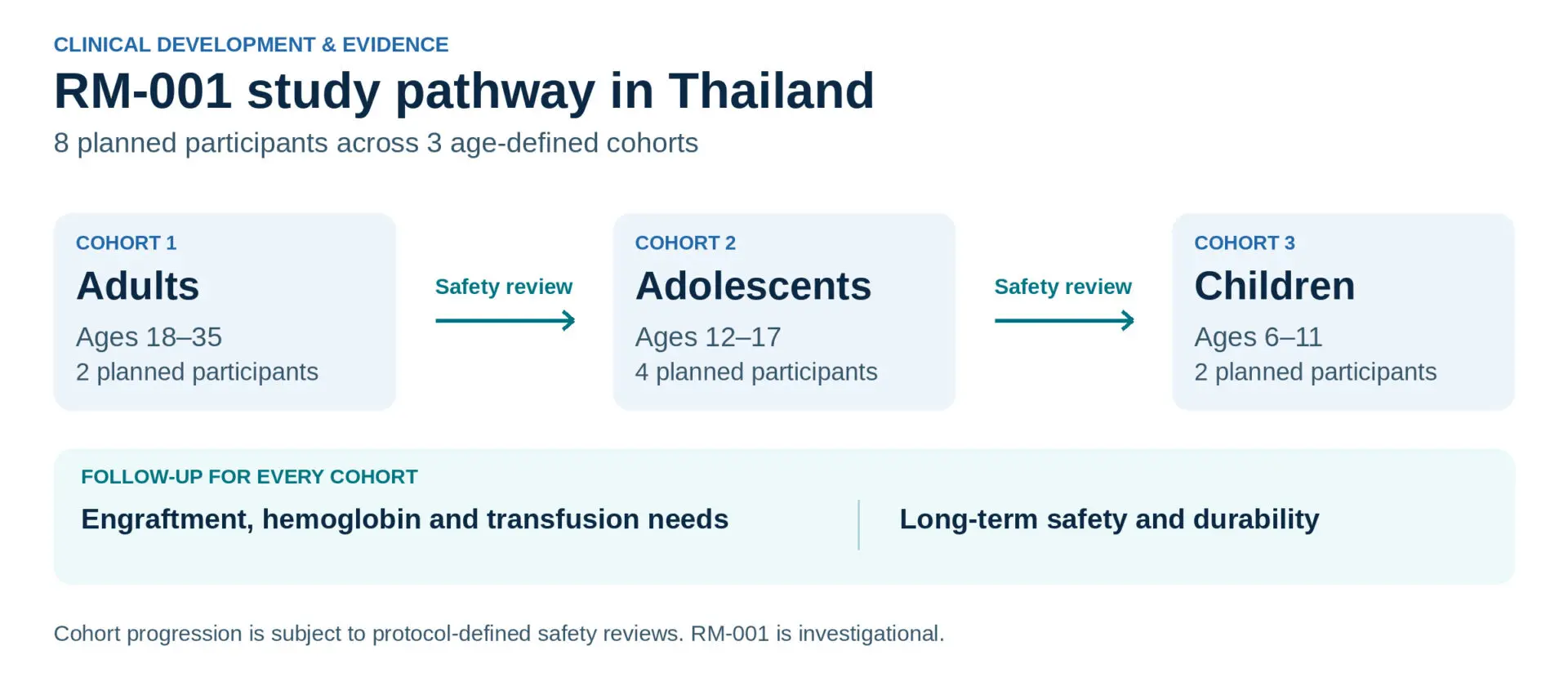
Following Thai FDA authorization of the clinical investigation on 19 October 2026, Nouvogenes is advancing an eight-participant study designed to evaluate RM-001 in Thailand.

Cohort 1 · Adults

Ages 18–35

Two participants planned in the initial adult cohort, followed by a protocol-defined safety review before progression.

Cohort 2 · Adolescents

Ages 12–17

Four participants planned, subject to safety review and applicable study requirements.

Cohort 3 · Children

Ages 6–11

Two participants planned, with progression dependent on the required preceding safety assessments.

Study outcomes

How Clinical Success Will Be Evaluated

Clinical evaluation must consider both the intended therapeutic benefit and the risks associated with stem-cell collection, conditioning, infusion, and gene editing.

Evidence domain

What it helps establish

Transfusion independence

The primary efficacy objective is transfusion independence for at least 12 months while maintaining hemoglobin of at least 9 g/dL, as defined by the study protocol.

Hemoglobin response

Total hemoglobin, fetal hemoglobin, and related laboratory assessments help characterize hematologic recovery and the biological effect of treatment.

Safety and tolerability

Monitoring includes adverse events associated with mobilization, apheresis, conditioning, infusion, engraftment, and gene editing.

Engraftment and recovery

Clinical and laboratory follow-up assesses hematopoietic recovery after infusion of edited autologous cells.

Durability and long-term follow-up

Extended observation is needed to understand sustained benefit and possible delayed safety signals beyond the initial efficacy assessment.

This is a public-facing summary, not a substitute for the current approved protocol, statistical analysis plan, or investigator guidance. Endpoint wording and visit schedules should be reconciled with controlled study documents before publication.

Risk and uncertainty

Evidence Must Address Benefit and Risk Together

Treatment-related risks

Conditioning and transplantation

Myeloablative conditioning and transplantation can involve serious adverse events, including infection, cytopenias, and organ toxicities. Specialist assessment and supportive care are essential.

Technology-related risks

Gene-editing safety

Characterization of editing outcomes, including potential unintended changes, forms part of product development, quality control, and longer-term safety assessment.

Clinical uncertainty

Response and durability

The consistency of clinical response, outcomes in different age groups, and long-term benefit-risk profile require continued investigation.

Evidence roadmap

What Comes Next?

The development program is designed to progress from initial treatment and safety monitoring to broader cohort evaluation, follow-up, and evidence-based regulatory submissions.

Near term

Patient treatment and early safety

Complete planned clinical activities for the initial cohort and assess safety before advancing to subsequent participants.

Intermediate term

Clinical follow-up and analysis

Evaluate transfusion requirements, hemoglobin response, engraftment, and adverse events as data mature.

Long term

Regulatory evidence package

Integrate clinical outcomes with manufacturing, quality, and long-term safety evidence to support future regulatory review, subject to study results.

Learn more

Explore the Science Behind RM-001

Understand the gene-editing mechanism and the specialized clinical pathway required to deliver an autologous therapy.