Current treatment burden
Repeated Transfusions
Ongoing transfusion schedules, iron management and monitoring can create substantial demands for patients, families and healthcare systems.

Science & Pipeline / Lead Program
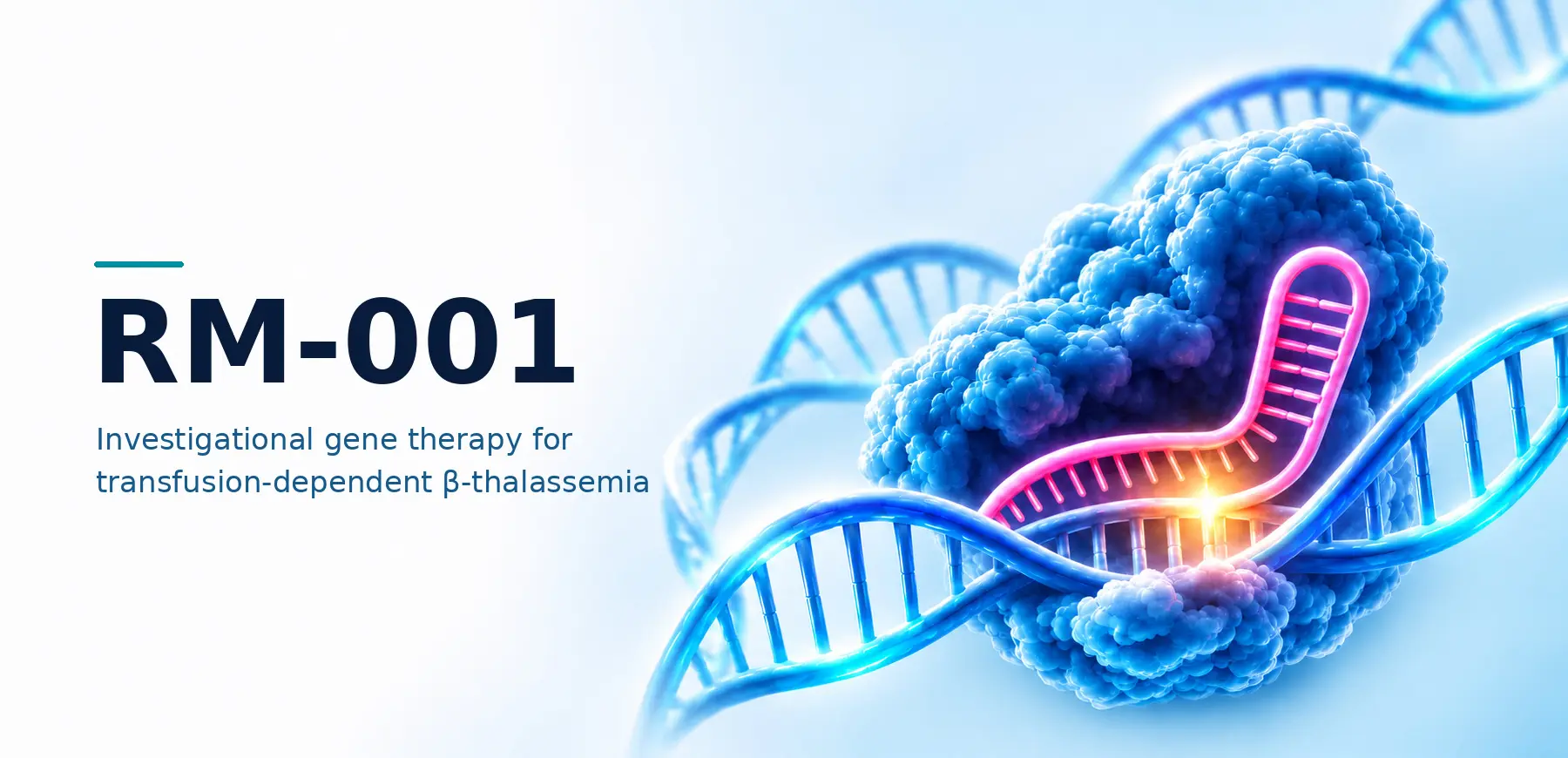
An investigational, autologous CRISPR/Cas9 gene-editing therapy being developed for transfusion-dependent β-thalassemia.
RM-001 is designed to reactivate fetal hemoglobin production using a patient's own blood-forming stem cells, with the therapeutic objective of eliminating the need for regular blood transfusions.
The unmet medical need
β-thalassemia is an inherited disorder in which insufficient functional β-globin compromises normal adult hemoglobin production. For people with transfusion-dependent disease, regular red-blood-cell transfusions are central to care, often alongside iron chelation and long-term monitoring for complications.
While allogeneic hematopoietic stem-cell transplantation can offer a curative option for some patients, access is constrained by donor suitability and treatment-related risks. A therapy based on a patient's own stem cells offers a different therapeutic approach, although it still involves intensive transplantation procedures and significant risks.
Current treatment burden
Ongoing transfusion schedules, iron management and monitoring can create substantial demands for patients, families and healthcare systems.
Clinical opportunity
The development objective is sustained production of sufficient functional hemoglobin to achieve transfusion independence.
Treatment pathway
Using the patient's own hematopoietic stem cells avoids the need for a matched donor, but does not eliminate conditioning-related risks.
Mechanism of action
Before birth, fetal hemoglobin (HbF) is a major oxygen-carrying form of hemoglobin. Its production normally declines after birth as adult hemoglobin takes over. Increasing HbF in red blood cells can compensate for deficient β-globin in β-thalassemia.
RM-001 uses CRISPR/Cas9 to edit regulatory regions in the promoters of the HBG1 and HBG2 genes in collected CD34+ hematopoietic stem cells. The intended effect is to increase γ-globin expression and thereby restore meaningful HbF production.
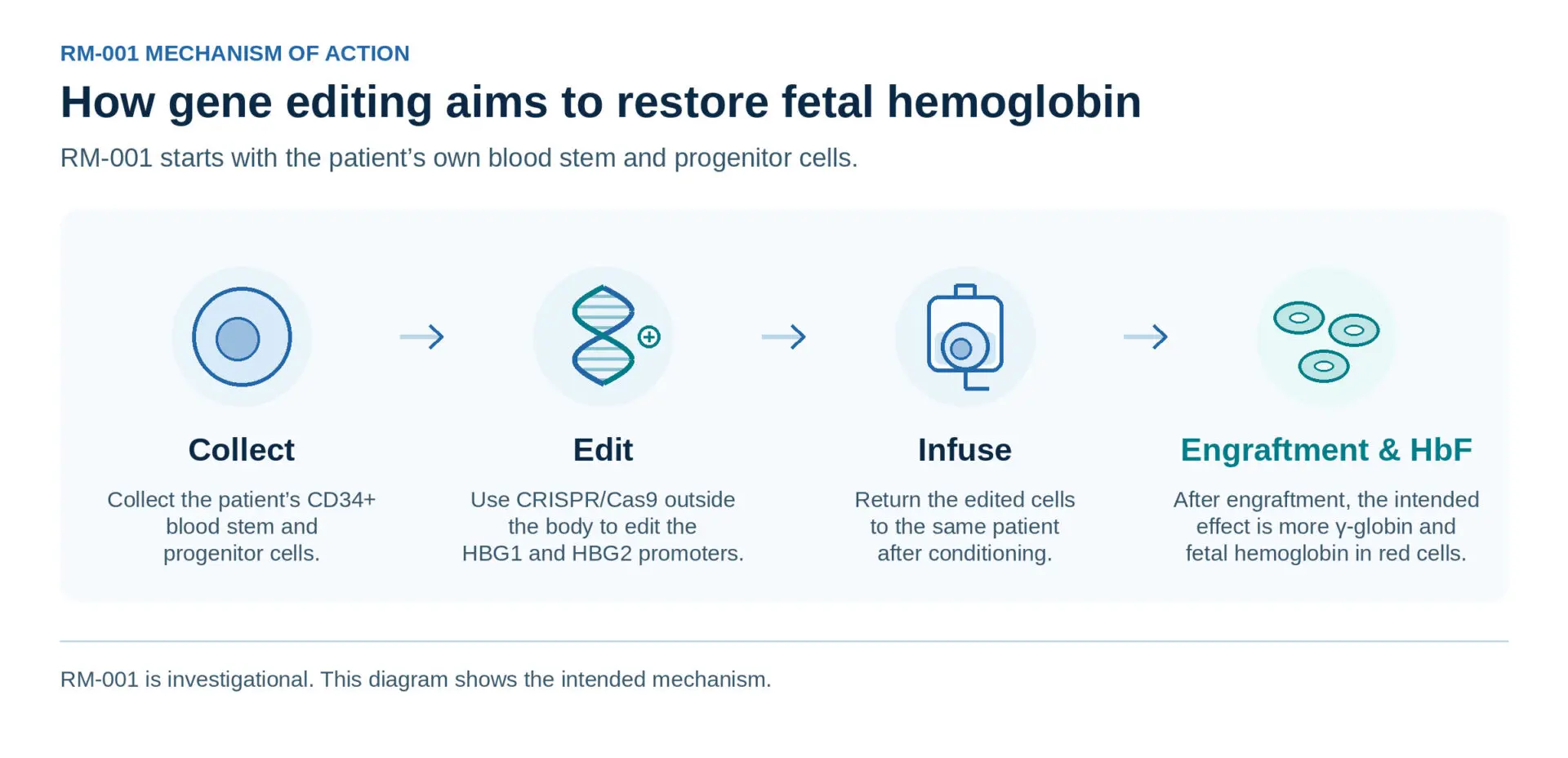
Patient's CD34+ stem and progenitor cells
Ex vivo CRISPR/Cas9 editing of HBG1/HBG2 promoter regions
Return edited cells following conditioning
Edited cells establish blood-cell production, including HbF
Important distinction: RM-001 is an ex vivo, non-viral gene-editing approach. Gene editing takes place outside the patient's body using CRISPR/Cas9 delivered by nucleofection; RM-001 is not a viral-vector gene-addition therapy.
How treatment is intended to work
RM-001 is a personalized cell-therapy process that depends on specialist hematologist eligibility assessment, apheresis, GMP manufacturing, cell infusion and engraftment, transplantation care, and long-term follow-up.
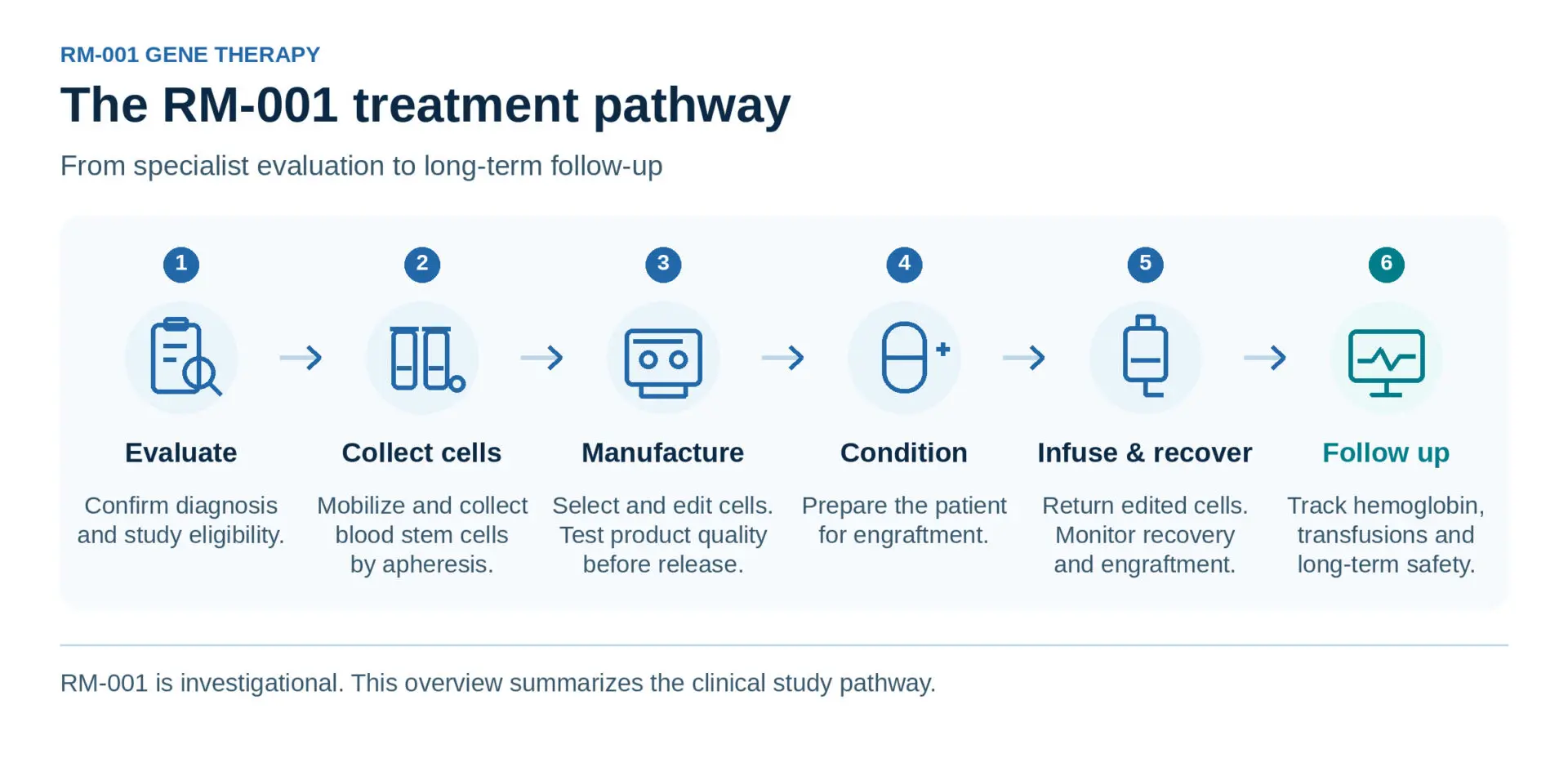
Confirm the diagnosis, assess organ function and transplantation suitability, and complete protocol-defined screening and eligibility procedures.
Mobilize and collect the patient's blood-forming stem cells for manufacturing.
CD34+ cells are sorted and edited ex vivo using CRISPR/Cas9 nucleofection. The required product-quality tests are performed before release.
Administer protocol-specified myeloablative conditioning to create space for the edited stem cells to engraft. Conditioning carries potentially serious short- and long-term risks.
Infuse the patient's manufactured cells and provide specialist supportive care while blood counts recover and engraftment is monitored.
Monitor hemoglobin, HbF, transfusion requirements, adverse events and longer-term outcomes according to the clinical protocol.
Development rationale
RM-001 builds on clinical experience with the licensed technology from China. Nouvogenes is advancing the program in Thailand under a Thai FDA-authorized clinical investigation. The objective is to evaluate whether the approach can provide sustained transfusion independence with an acceptable safety profile in the study population.
Clinical endpoints
Assessment of whether patients can maintain protocol-defined hemoglobin levels without regular red-blood-cell transfusions over the specified follow-up period.
Biological activity
Monitoring total hemoglobin, fetal hemoglobin and related measures to understand the biological effect of edited-cell engraftment.
Safety & durability
Evaluating treatment-related adverse events, conditioning effects, engraftment, and the durability of response over time.
Platform and execution
Autologous gene therapy must be manufactured separately for each patient. Reliable CD34+ cell processing, controlled gene editing, product characterization, cryopreservation, logistics, and GMP quality systems are therefore fundamental to both clinical development and future scale-up.
Nouvogenes' strategy connects licensed gene-editing technology with local clinical development, specialized manufacturing partnerships and qualified hospital capabilities. Manufacturing readiness and treatment-center coordination are essential to the pathway toward potential patient access.
Our approach
Our goal is to build a reproducible, quality-controlled pathway that can support the development of RM-001 and inform future gene therapy programs.
Understanding the risks
Although RM-001 has a defined biological rationale and prior clinical experience with the licensed technology, its safety, efficacy and durability in the Thai clinical program remain under evaluation. Clinical results may differ across patients and settings.
Safety
Stem-cell mobilization, apheresis, myeloablative conditioning, infusion and recovery each carry risks, including potentially serious adverse events.
Gene editing
Evaluation includes editing performance, product consistency, and potential unintended editing-related effects that warrant careful assessment and follow-up.
Clinical outcomes
Long-term benefit, patient selection, manufacturing capacity, and regulatory authorization must be established before broader use can be considered.
Development status: RM-001 is an investigational therapy and is not approved for commercial use. Participation in any clinical study is subject to eligibility, informed consent, protocol requirements and institutional oversight.
Learn more
Discover the clinical evidence, manufacturing approach and collaborations supporting the development of RM-001.